
Traditional timber framing relies on mortise and tenon joinery, a connection so time-tested that it has held structures together for centuries without a single piece of metal. But there are situations where wood alone simply can't carry the load, particularly in connections subject to high tension forces. When that happens, the right answer isn't to abandon traditional joinery, it's to reinforce it with steel.
Adding an all thread rod to a mortise and tenon joint is one of the most practical and proven ways to do exactly that. It's not a modern compromise; timber framers have combined wood joinery with iron hardware for hundreds of years. Today, with readily available threaded rod, washers, and nuts, it's easier and more reliable than ever.
When Is All Thread Necessary?
Most timber frame connections handle their loads through the bearing strength of the wood and the shear resistance of wooden pegs. That works well for joints under compression or moderate loading. The problem arises when tension enters the picture.
Roof connections are the most common culprit. Rafter loads, wind uplift, and the outward thrust of a pitched roof all create tension at beam-to-post and rafter-to-plate connections. Wooden pegs are strong in shear but far less capable in tension, and under significant uplift forces they can fail without warning. All thread rod, by contrast, is excellent in tension, it ties the joint together in a way that pegs simply can't match.
Other situations that commonly call for all thread reinforcement include:
- Long horizontal beams housed into posts where the connection sees both gravity load and lateral tension
- Ridge connections on high-pitch or heavy-snow-load roofs
- Exposed outdoor structures like pavilions and covered patios where wind uplift is a design factor
- Any connection where the engineer specifies a minimum tension capacity
The Anatomy of the Joint
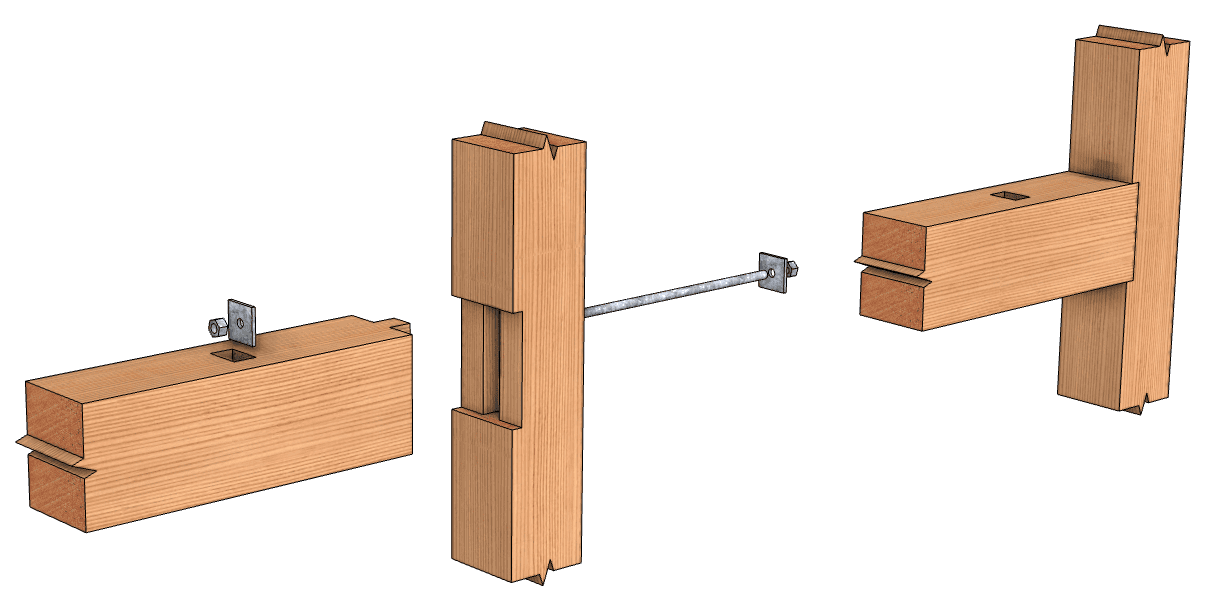
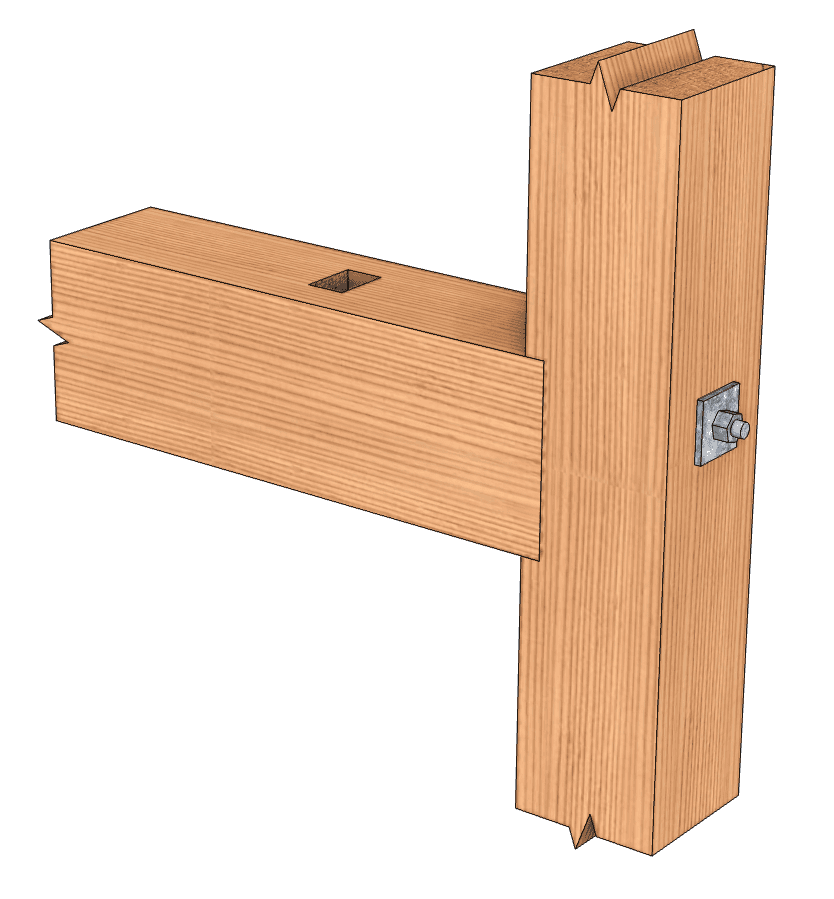
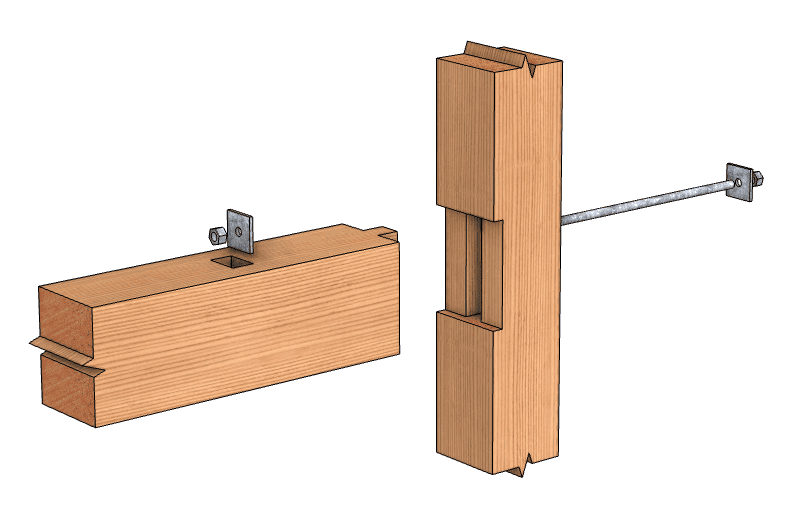
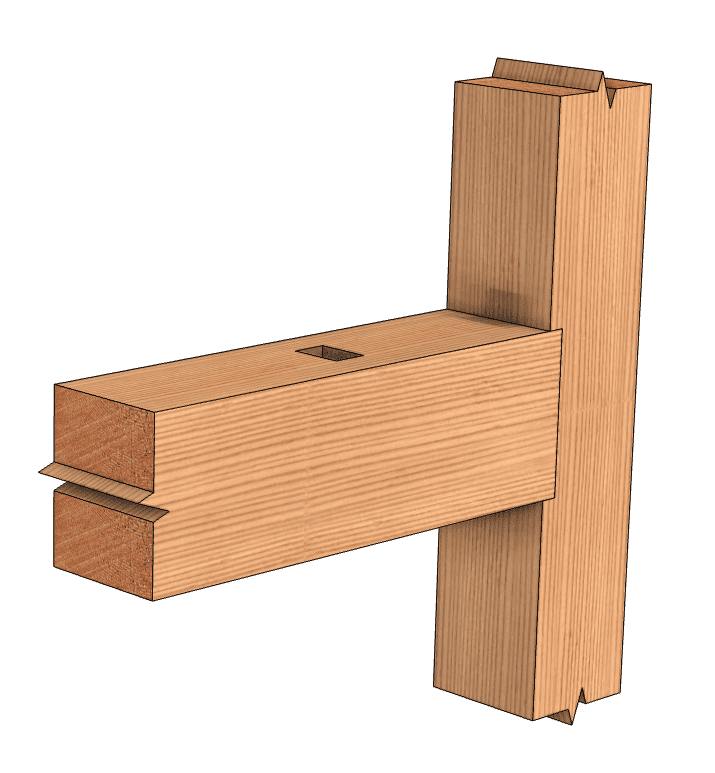
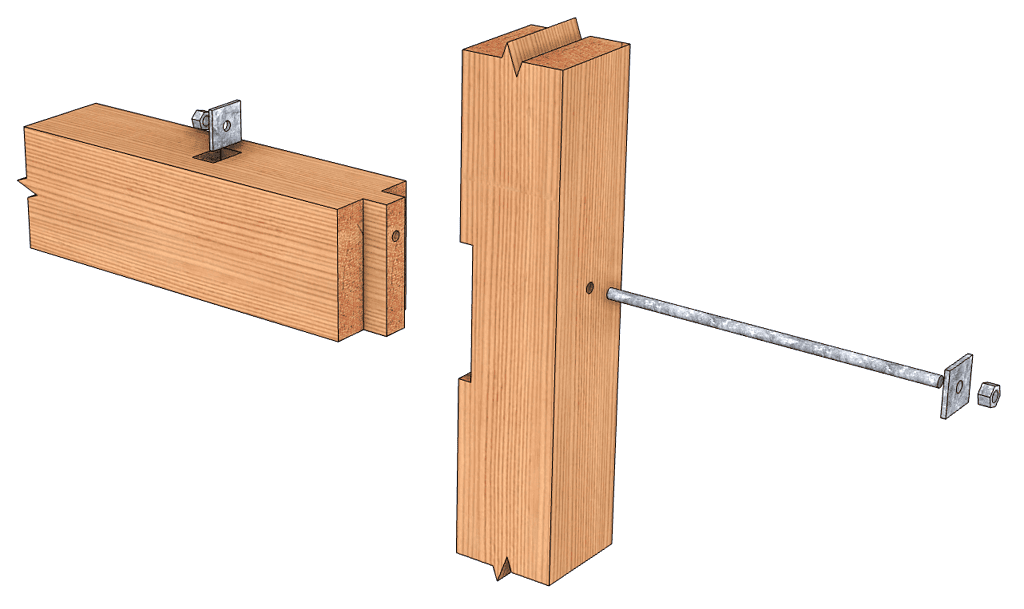
The joint shown here is a housed beam connection into a post, one of the most common configurations in timber frame construction. A small stub tenon on the end of the beam fits into a corresponding mortise in the post. This tenon isn't carrying the structural load; it functions primarily as a locator, keeping the beam properly positioned during the raise and preventing any lateral movement once the structure is up.
The real structural work is done by the all thread rod running through the joint. The rod passes through a pre-drilled hole in the post and into a channel bored through the beam, then is secured on both ends with a heavy washer and nut. The bearing area of the washer distributes the clamping force across the face of the wood, preventing the nut from pulling through the timber under load.
Hardware Specifications
For most beam-to-post connections in residential timber frame construction, 1/2", 5/8" or 3/4" diameter all thread rod in A36 or A307 grade steel is a common starting point. The rod diameter should be matched to the calculated tension load — sizing up for heavier roof spans or higher snow and wind loads, sizing down for lighter decorative connections.
Washers are typically 3" x 3" x 1/4" plate washers rather than standard hardware store washers. The larger bearing area is essential — a standard washer concentrates load on too small a surface and can crush into the wood over time, loosening the joint. Heavy hex nuts are used on both ends, and in some applications a second nut is run against the first to prevent loosening from vibration or seasonal wood movement.
All thread rod is widely available at home improvement stores and fastener suppliers in standard lengths, and it's easy to cut to any dimension with a reciprocating saw or angle grinder. Threading is continuous, so hardware can be positioned anywhere along the rod's length.
Engineering Matters
The joint geometry shown here is straightforward, but don't let that simplicity suggest the engineering is optional. The rod diameter, washer size, hole placement, and edge distances all affect the connection's capacity and need to be appropriate for the actual loads in your frame. Always consult a licensed structural engineer when designing connections that carry significant tension — particularly in roof systems, long-span beams, or structures in high wind or snow regions.
The combination of traditional mortise and tenon craftsmanship with the tension capacity of steel hardware represents timber framing at its most practical: proven methods working together to build structures that last.
Brice,great work I really enjoy seeing your work.
It is so nice that you share this on Google+ , please keep up the work…
Paul H. Cooper
Thanks Paul,
More on the way.
Cheers,
Brice