

Robert Oshatz’s Floating Fennell House
Glue-laminated timber (glulam) is a structural engineered wood element commonly used for beams and columns in residential and commercial applications. Glulam is a highly visible form of mass timber in contemporary projects, with long spans framing signature designs that have been left exposed to take advantage of wood’s natural aesthetic.
The Strength of Glue-laminated timber
Glulam is stronger than steel at comparable weights, and it is stronger and stiffer than dimensional lumber, according to APA – The Engineered Wood Association. That makes the material a cost-effective choice for long, structural spans and tall columns with minimal need for additional support.
This engineered wood product can be used in interior and exterior applications. Several manufacturers sell glue-laminated timber products with adhesives that can withstand moisture and wear from use outdoors.
How Glulam Can Be Used
To form a glulam component, wood laminations (dimension lumber) are positioned according to their stress-rated performance characteristics. In most cases, the strongest laminations sandwich the beam in order to absorb stress proportionally and ensure the member’s longevity, APA notes. The laminations are jointed end to end, allowing for long spans, and are bonded with a durable, moisture-resistant adhesive. The laminations’ grains run parallel with the member’s length to improve its strength.
These structural members come in standard and custom sizes. Depths range from 6 inches to 72 inches, and widths range from 2.5 inches to 10.75 inches, according to APA. Components are cut to length when ordered and can surpass 100 feet. Commercial projects often require longer spans and accommodate bigger loads than residential projects, meaning custom widths and depths are often required. In addition to straight spans, glulam can also be used for curved and pitched applications.
Four appearance grades—framing, industrial, architectural and premium—suit glulam for use in a range of architectural applications. Those include commercial buildings such as churches, higher education facilities and offices, as well as homes, where they offer a combination of structural and aesthetic attributes.
This product can work behind the scenes, too, as trusses, purlins, floor beams, cantilevers and other necessary structural elements, according to APA. Glulam has also found use as floor and roof decking planks. Elsewhere in the built environment, glulam can be found as a key structural element in bridges, poles and marina docks.
Glue-laminated timber Used in Timber Framing
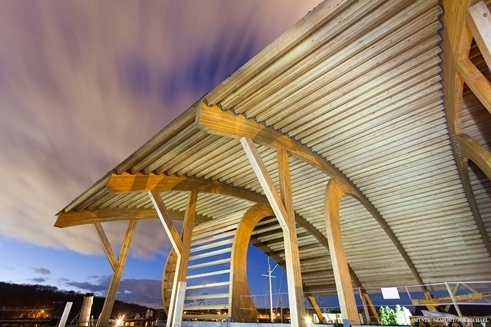
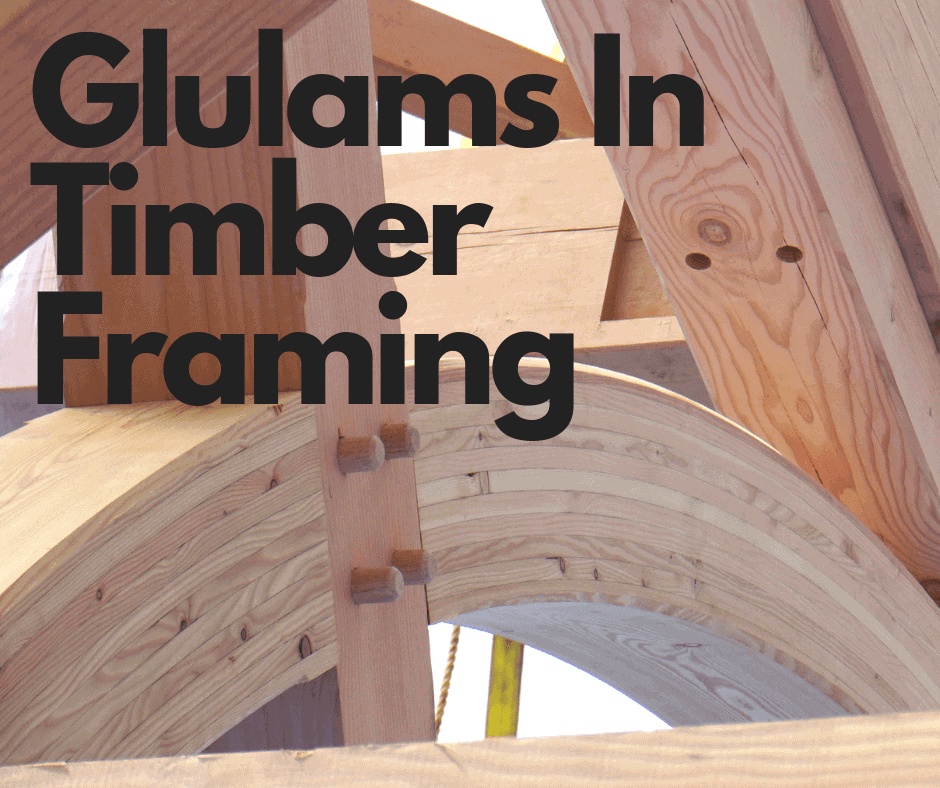
A glulam system in a timber frame structure can give you increased flexibility. Trusses can span longer distances with fewer interior posts, providing the opportunity to create wide-open spaces. Glue-laminated timber is perfect for arched bottom chord trusses or curved timbers in other areas of the structure. With glulam there is very little checking and shrinking as compared with traditional solid timbers, creating a cleaner and less rustic look. A glulam timber frame creates a sleeker, more modern look than traditional timbers.
Parts of this article are courtesy of Think Wood – an organization devoted to promoting the economic, environmental and societal benefits of using softwood lumber in commercial, community and non-residential building applications.
I am currently working on a design in which the owner is asking for glulam timber, exposed and done well. I have experience in both traditional timber framing and glulam and lvl timber.
I found a link to this article and wondered if you had explored this option in more detail elsewhere.
Thank you,
Stephen Bobb
Hello. Could you help us with manufacturing a spherical building with Structural Veneer Lumber? I can send more information by email. Thank you.
Thank you for your question but we do not deal with Structural Veneer Lumber
Hi my name is David I live in Arkansas and I own a piece of land not have access to White oak timber in pine timber I wanted to build a timber frame roof because I can get the timbers milled and dried for the trade of my labor
So I need help because the county wants an engineered sealed roofing design I’ve been building houses for 47 years pretty much all my life I don’t have much money I’m living in a camper on three acres no running water no septic and trying to move forward and get a plan submitted to the county. Basically want a 20 ft deep 28 ft long you know building with concrete piers down to a lug footer and have four timber frame rafters sitting directly on top of the pier so it’ll be a direct download all I want the bottom cord and of course the top cord and of course I’ll need webbing I’m hoping to direct download in the center but I’d prefer not to have it I wanted to space these timber frame rafter 7 ft apart with 2×6 tongue and groove sheeting on top then I was planning on putting four inch insulation styrofoam 4×8 sheets and moisture barrier then my purlins on top probably 2×6 purlins space 2 ft apart running horizontally across my timber frame roof then metal roofing on top what would it cost to do this engineering seal or design of timber framed rafter I was going to use steel plates through bolted at the connections of the webs and of course tie down at the wall the column will be a 8×8 CBS block poured solid with two number five rebar in a j bolts bolting raptor directly down to the top of Piers. Problem I have is a 7-ft spacing apartments that only have to make four of these timber rafters
David, I understand your frustration but if the county needs it engineered there is very little you can do. We run into it all the time. You can get your timbers graded which may help you out. https://timberframehq.com/how-to-get-your-timbers-graded-or-stamped-for-timber-framing/. They are not setup for people like us. In the end I needed my frame to be engineered and the timber graded. https://timberframehq.com/4-tips-on-working-with-your-local-building-code-office-with-your-diy-timber-frame-construction-project/