
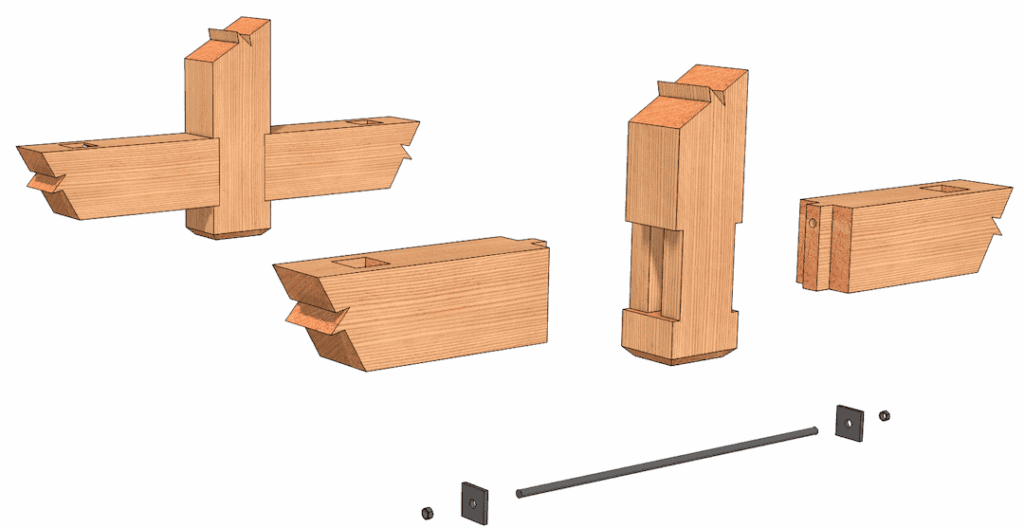
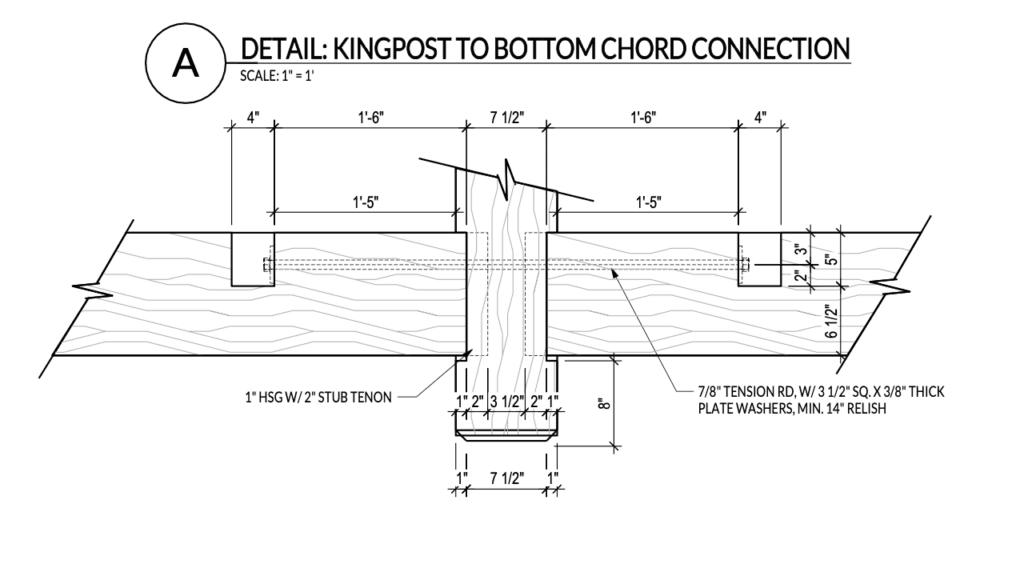
The king post truss is one of the most enduring forms in timber framing, having supported roofs for centuries. At its heart lies a critical connection: where the vertical king post meets the horizontal tie beam. Traditionally, this joint used a through-tenon that passes completely through the tie beam and is secured with hardwood wedges or pegs. While beautiful and time-tested, this approach requires removing substantial material from both members and demands high precision.
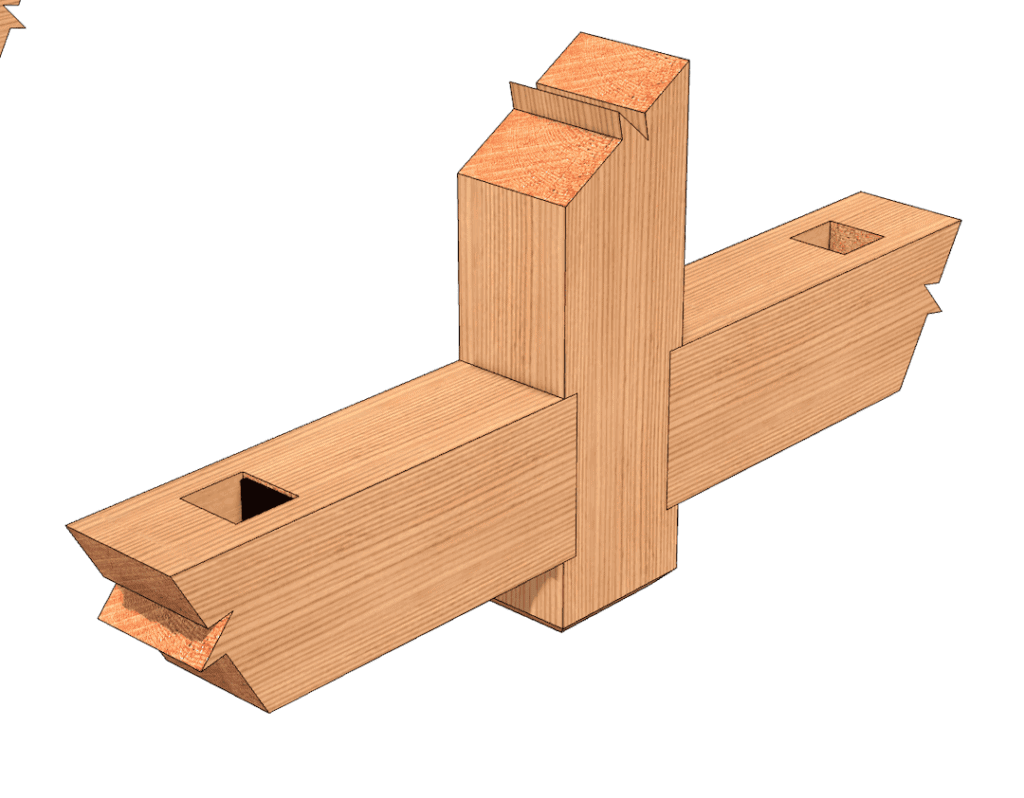
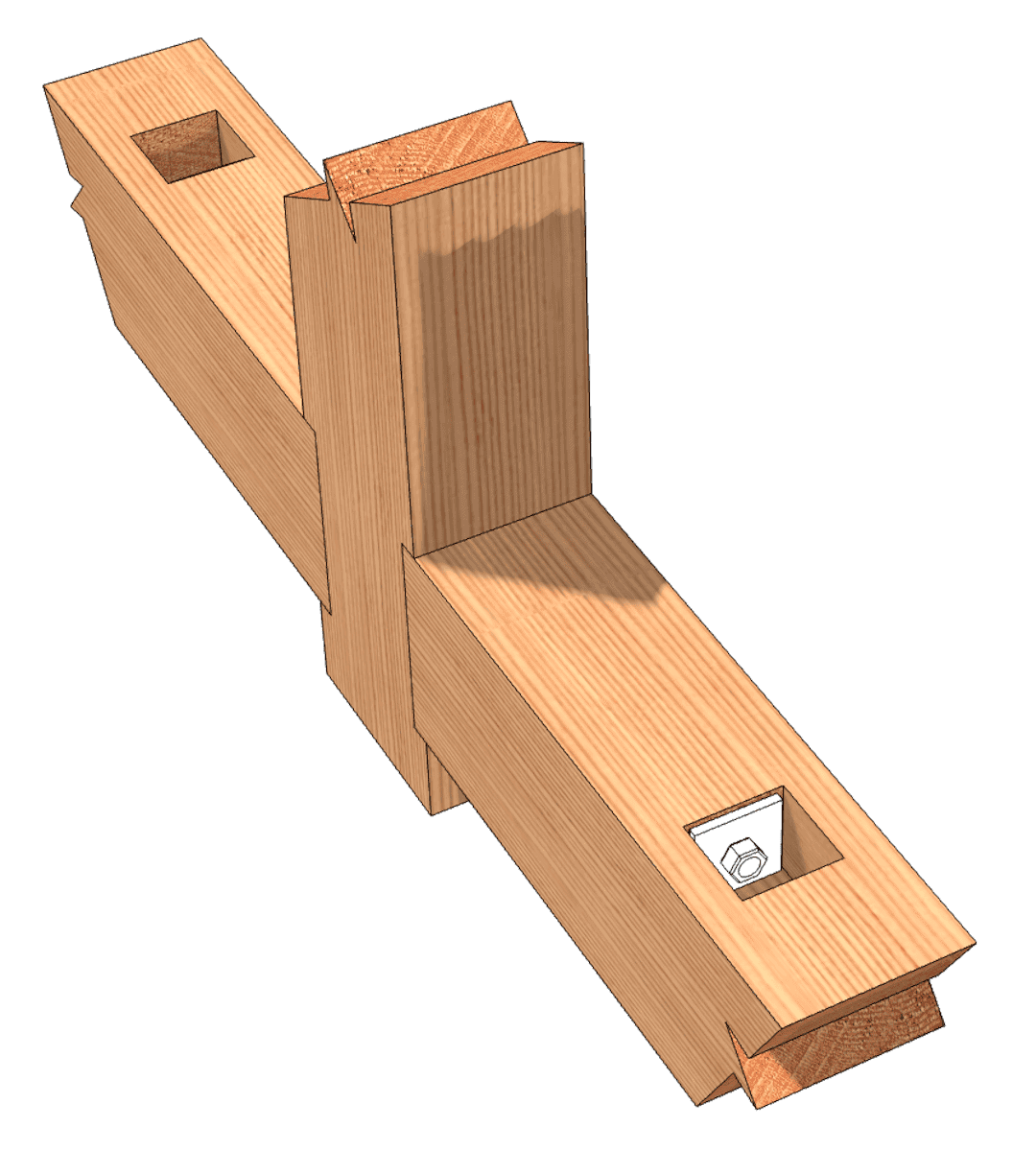
The king post-to-tie beam connection using all-thread and bolts represents a hybrid approach that honors traditional aesthetics while leveraging modern materials to create a stronger, more efficient joint with less material removal.
Understanding the Joint
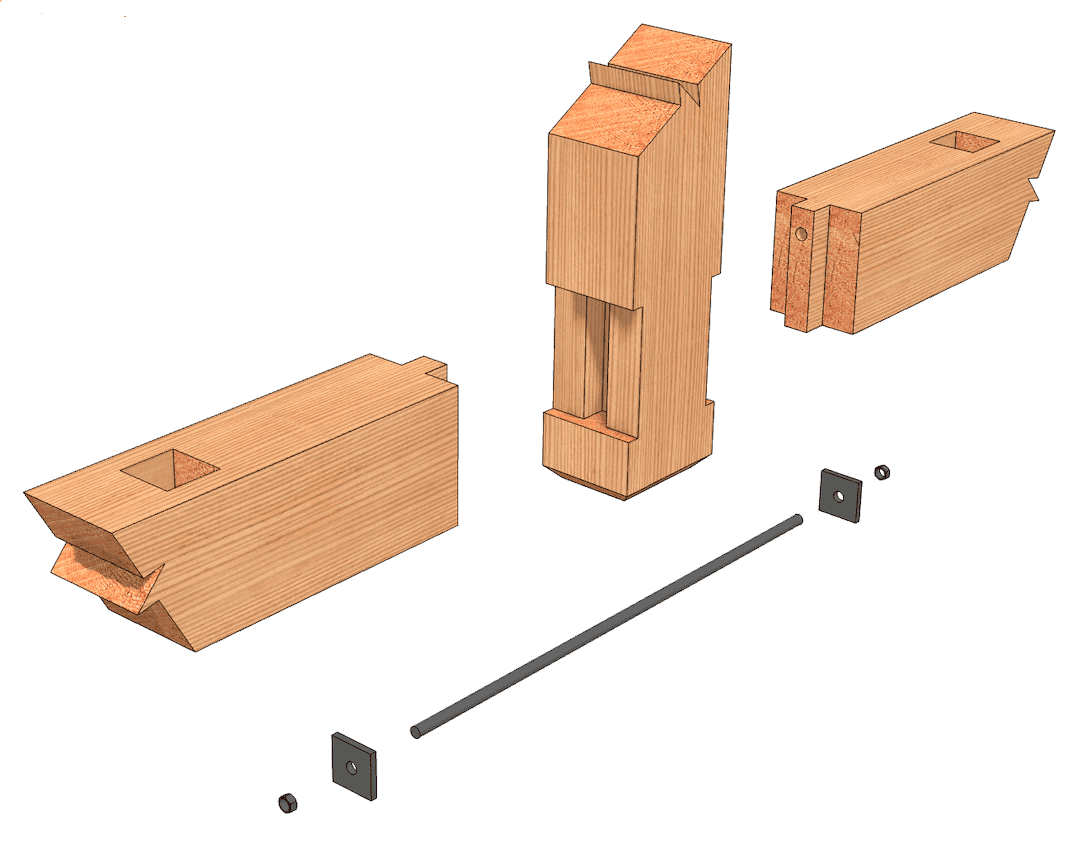
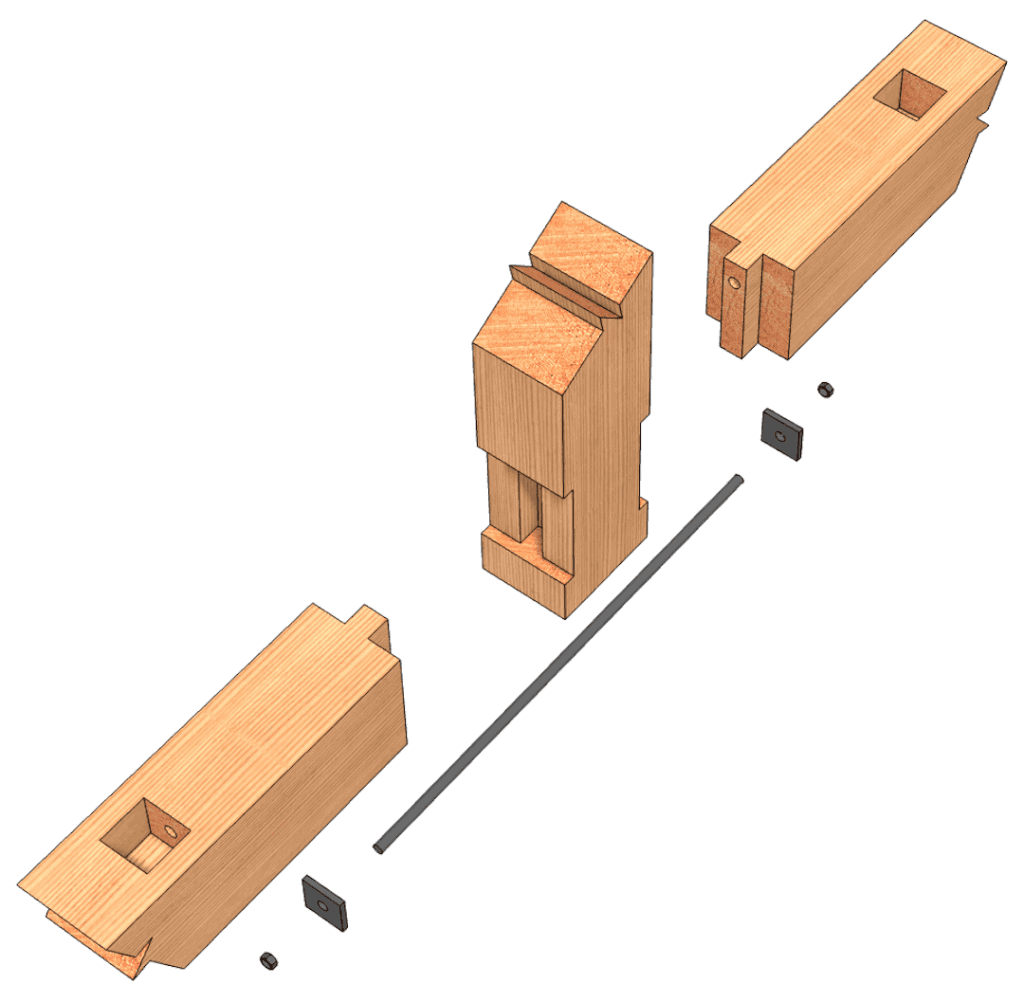
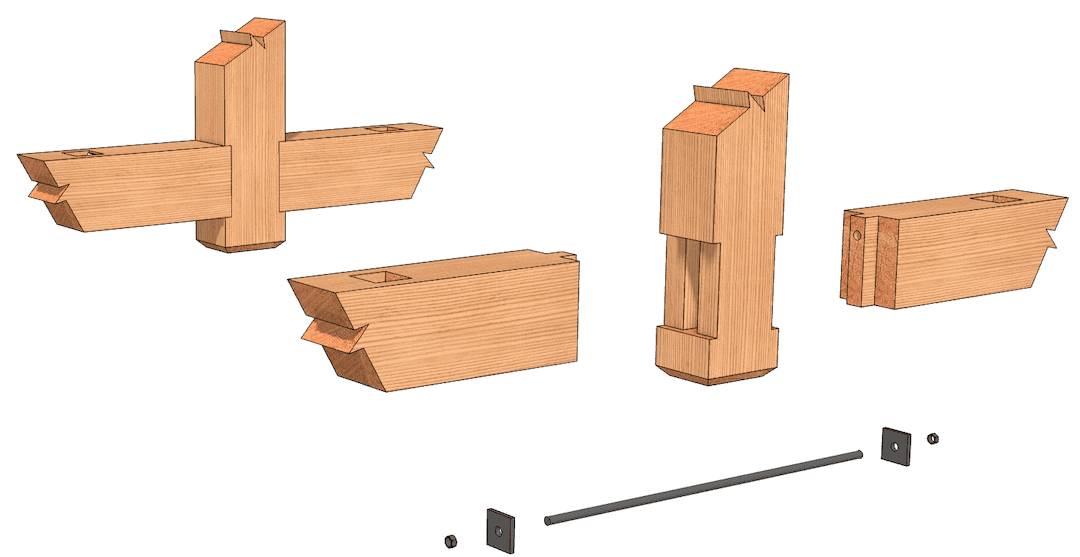
This connection consists of four key components:
- The King Post: A vertical timber extending from the truss apex down to the tie beam, featuring a reduced tenon at its base that helps position the joint during assembly.
- The Tie Beam: A horizontal timber spanning between posts or walls, resisting the outward thrust from roof loads.
- The All-thread Rod: A threaded steel rod running vertically through both timbers, providing the primary tensile strength.
- Bearing Plates and Hardware: Steel plates that distribute the load from the all-thread across the timber surface, with nuts compressing the joint together.
How It Works
When roof loads push down on the rafters, they create pressure that wants to sag the tie beam and spread the walls. The king post counters this by working in tension—hanging from the roof peak and pulling upward on the tie beam's center.
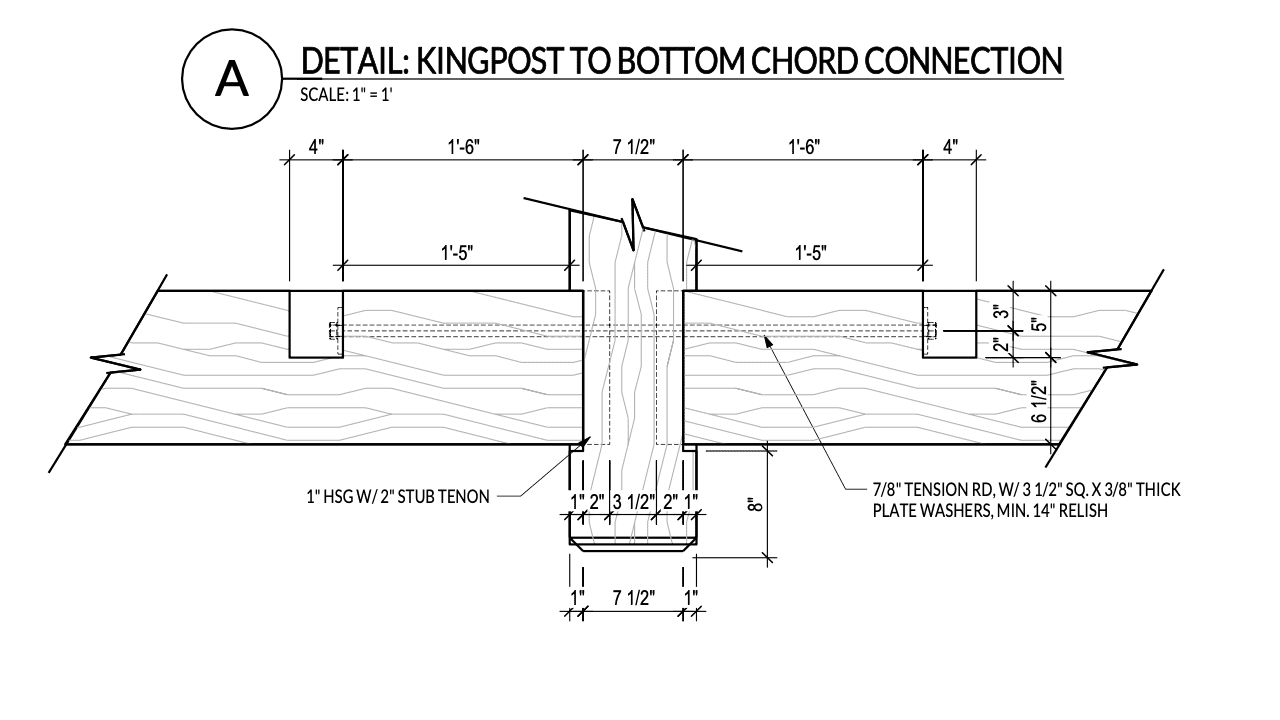
In this connection, the steel rod carries most of the tensile load through the timber cores. The reduced tenon provides lateral stability, preventing the king post from shifting sideways while the all-thread handles the pulling forces. This division of labor is key: wood handles compression bearing, steel handles tension.
Advantages
Preserving Timber Integrity
Traditional through-tenon joints remove 30-40% of the tie beam's cross-section. For a beam working in tension, this significantly weakens it exactly where strength is needed most. The all-thread approach requires only a 3/4" to 1" diameter hole plus a shallow mortise, leaving far more material to resist tensile forces.
Installation Efficiency
- Faster Cutting: Drilling centered holes is considerably faster than hand-cutting precise through-mortises and extended tenons.
- Easier Fit-up: The all-thread provides adjustment capability during assembly. Slight misalignments can be accommodated, whereas traditional wedged tenons require recutting if alignment is off.
- Field Adjustment: Nuts can be retightened as timbers season and shrink. Traditional pegged joints offer no such adjustability once assembled.
- Reduced Skill Threshold: While timber framing always demands skill, drilling accurate holes is more forgiving than cutting perfect mortise and tenon joints.
Technical Best Practices
Sizing the All-thread
Rod diameter should be determined by engineering calculations based on tie beam span, roof loads, timber species and grade, and building code requirements. Common sizes range from 5/8" for lighter residential applications to 1" or larger for heavier loads. Engineering must verify the all-thread capacity exceeds calculated tension with appropriate safety factors.
Bearing Plate Design
Plates distribute concentrated loads across timber surfaces, preventing local crushing. They should be:
- Sized generously (4"x4" minimum, larger for heavier loads)
- Thick enough to resist bending (1/4" to 3/8" steel plate)
- Positioned on solid wood, avoiding knots
- Recessed for aesthetic purposes
The Reduced Tenon
While all-thread carries primary tensile loads, the reduced tenon provides:
- Lateral Restraint: Prevents rotation and lateral shifting
- Installation Guide: Helps position and align during assembly
- Bearing Surface: Provides some compression bearing
The tenon should be 2" to 4" deep—enough for meaningful support without significantly weakening the tie beam. A common configuration uses a centered tenon that's 2" thick and 3" to 4" deep on 8"x8" or larger timbers.
Hardware Concealment
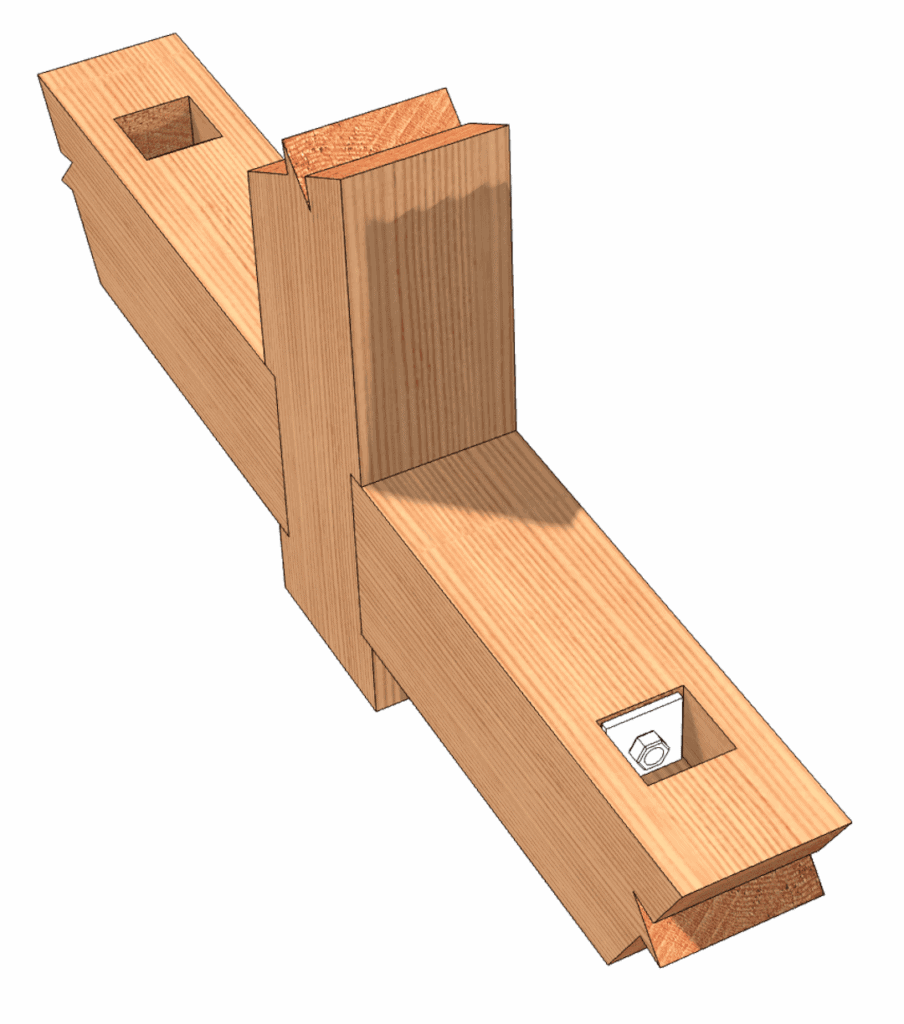
The top bearing plate recesses into the king post bottom, hiding hardware when viewed from below. Similarly, the bottom plate can recess into the tie beam's top surface, keeping the bottom face uninterrupted by visible metal.
Recesses should be:
- Slightly larger than plates for easy placement
- Deep enough to fully contain plate and washer
- Clean-cut with square corners
- Positioned to avoid wood defects
Aesthetic Considerations
With careful detailing, hardware can be nearly invisible. Recessed plates hide within timber surfaces, leaving only natural wood visible. Alternatively, exposed hardware can become a design feature in contemporary frames, with attractive nuts and custom plates expressing honest structure.
Decorative finials can be hollow-bored to slip over protruding all-thread. Chamfered edges and decorative profiles add visual interest. Use penetrating oils for finishes allowing wood movement and retightening capability. Protect steel from corrosion—use galvanized or stainless steel in high-moisture applications.
Maintenance
Inspect quarterly during the first year for loosening, gaps, checking, or corrosion. Retighten as needed. After the first year, annual inspections suffice. When properly designed, installed, and maintained, these connections perform reliably for the structure's life—potentially centuries.
Conclusion
The king post to tie beam connection using all-thread represents timber framing's evolution. It doesn't replace traditional joinery—nothing matches expertly cut mortise and tenon beauty. Rather, it adds another option offering practical advantages in strength, speed, and structural performance.
For production shops, engineered projects, or efficiency-driven situations, all-thread delivers reliable results with less material removal and faster fabrication. For hybrid frames incorporating steel elements, it fits naturally. For framers valuing traditional aesthetics but needing engineered connections, it provides strength while hiding steel within timbers.
Choose based on your priorities: craft demonstration or efficiency? Historical reproduction or contemporary structure? Engineering requirements? Green or dried timber? The answers guide appropriate joinery choice.
Master timber framers understand good craftsmanship means choosing wisely from all available methods to create strong, beautiful, lasting structures. The all-thread connection is simply another well-designed tool. The vertical steel rod, hidden within timbers, silently carries enormous loads while wood presents the warm, natural aesthetic that has drawn people to timber framing for generations—a perfect example of thoughtful design honoring tradition while embracing modern materials and methods.
This is what I needed. I am having a hard time locating 24′ hardwood for the tie beams. Thanks