
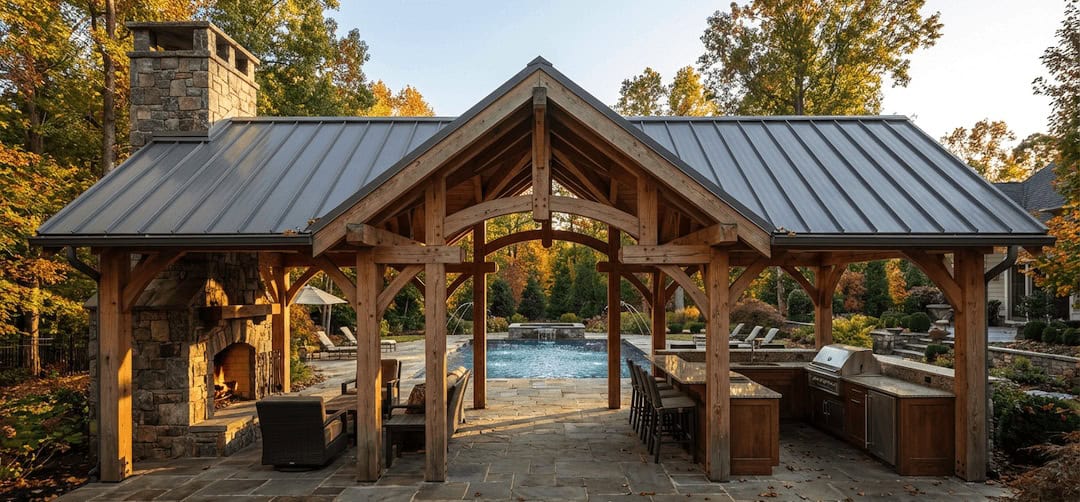
One of the most common questions we get from homeowners and builders goes something like this: "Do those trusses actually hold up the roof, or are they just for show?"
It's a smart question — and the honest answer is: it depends on the project. Timber framing can serve a purely structural role, a purely decorative one, or somewhere in between. Understanding the difference matters whether you're designing a new home, adding character to an existing space, or deciding how to spec a covered patio or barn.
Let's break it down.
What Is Structural Timber Framing?
Structural timber framing is weight-bearing. The timbers are doing real work — carrying roof loads, floor loads, snow, wind, and everything in between. If you removed them, something above would need to be re-supported.
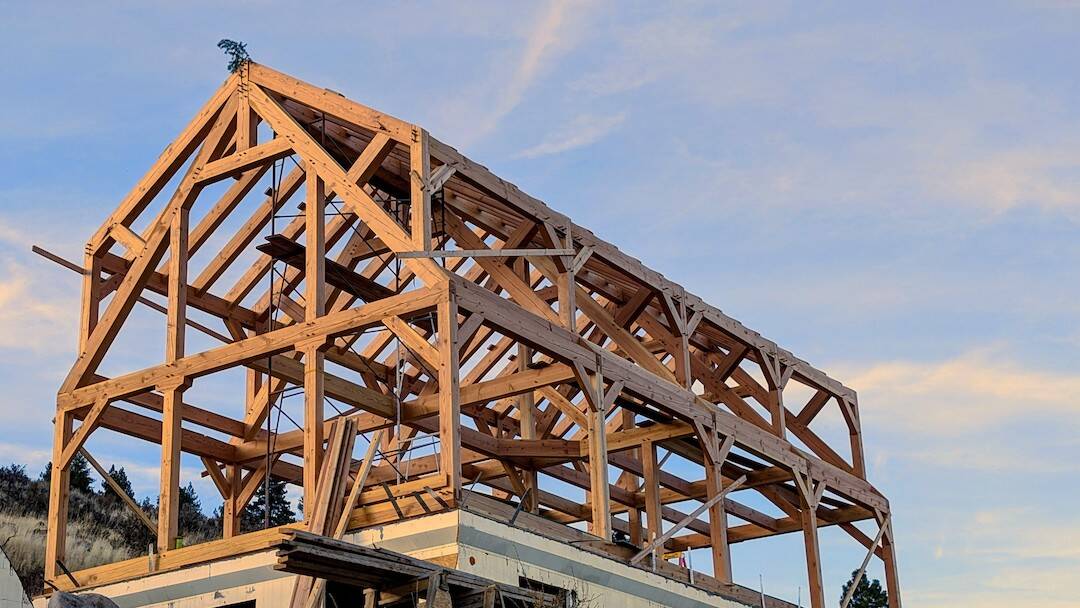
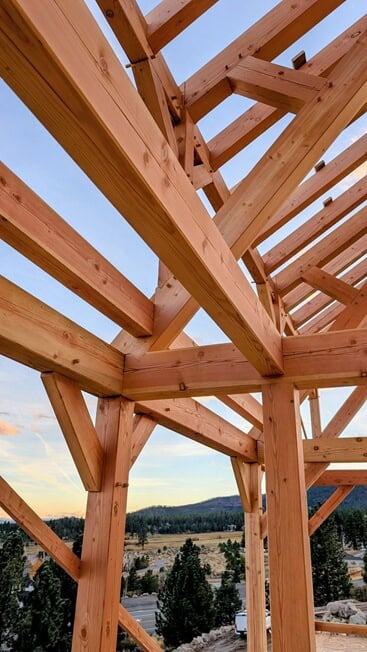
In a traditionally framed timber home, the entire skeleton is structural. Posts carry the load of the beams, beams carry the load of the rafters, and rafters carry the roof deck, insulation, and roofing. Every joint is engineered to transfer load safely through the frame.
At Timber Frame HQ, our ready-to-raise kits are fully structural. Every timber is CNC-cut to exact tolerances, every mortise-and-tenon joint is precision-fitted, and the frames are designed to meet local engineering requirements for load, span, and seismic or wind zone, as applicable.
Pros of Structural Timber Framing
- Authenticity by default. Because the timbers are actually engineered to carry a load, the sizing and spacing look right — there's no guesswork about proportions.
- Replaces conventional framing. Structural timbers can eliminate or reduce the need for dimensional lumber framing, which partially offsets their cost.
- Durability. Properly dried and protected timber framing routinely lasts for centuries. Many colonial-era timber frames are still standing.
- Fire performance. Large-section timbers char on the outside in a fire rather than failing quickly. This gives occupants more time to exit safely — a significant advantage over steel or light-frame construction.
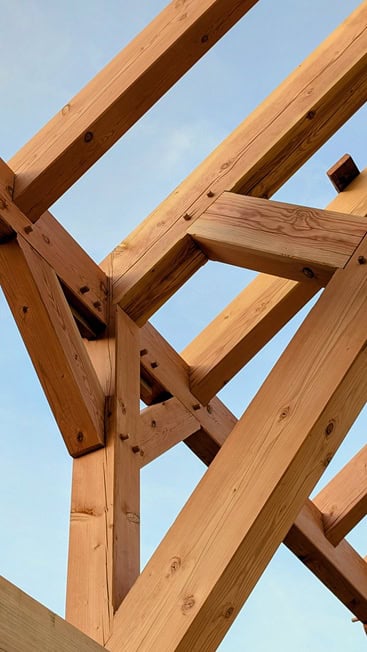
- Exposed joinery as a feature. With structural timber, the joinery is on display. Mortise-and-tenon connections, wooden pegs, and knee braces become design elements rather than afterthoughts.
Cons of Structural Timber Framing
- Higher upfront cost than conventional 2× framing, though offset by reducing other framing materials.
- Requires engineering sign-off in most jurisdictions. This isn't usually a major cost item, but it is a required step.
- Must be planned early. Structural timber needs to be integrated into the design from the start, not added later. It's in the ground early in construction, which means it must be protected from weather and other trades during the build process.
What Is Decorative (Non-Structural) Timber Framing?
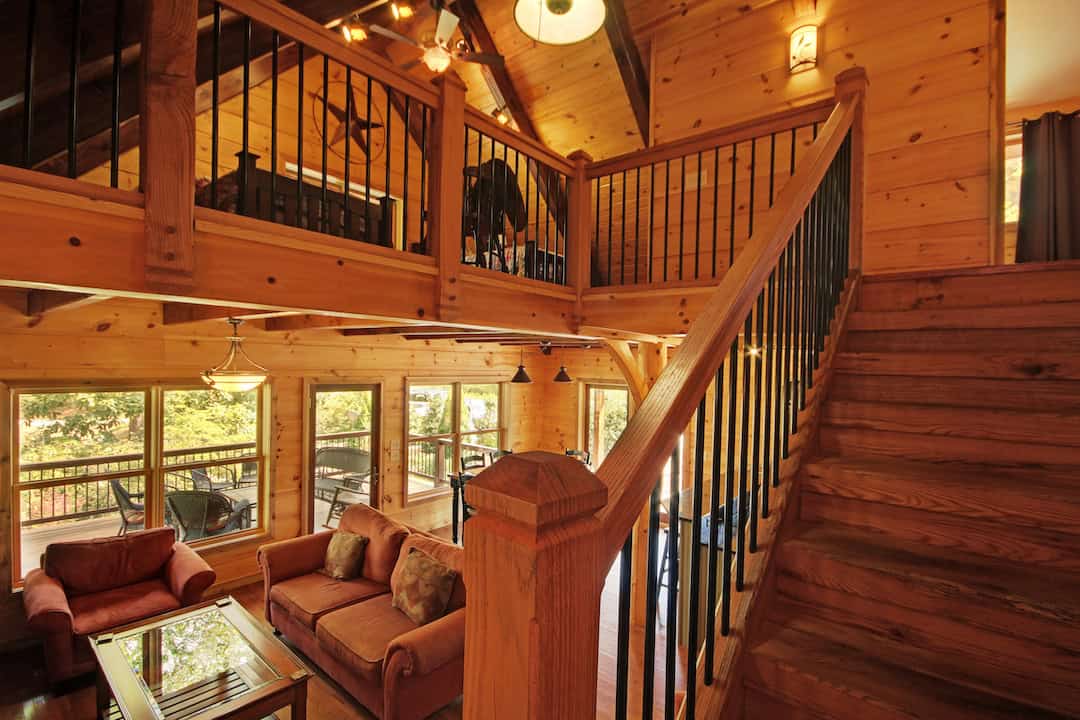
Decorative timber framing — sometimes called trimber framing, non-structural or aesthetic timber framing — is installed for visual effect. The timbers aren't holding anything up; the real structural work is being done by conventional framing hidden above or behind them.
A common example: a great room with 2×10 ceiling rafters carrying the roof load. Timber trusses are then installed below those rafters, attached to the structure but not contributing to it. To the eye, it appears to be a fully timber-framed space. Technically, the timbers are passengers.
This approach is extremely popular for additions, remodels, and situations where a homeowner wants the look of timber framing without a full structural redesign.
The Golden Rule for Decorative Timber Framing
If it's going to look decorative, it will look wrong. The goal is for the timbers to be visually indistinguishable from structural ones. That means getting three things right:
- Spacing. Structural trusses in a great room typically land every 6 to 8 feet. A room that's 24 feet long might have trusses at 6', 12', and 18' — occasionally with half-thickness end trusses at each gable wall that appear to be partially embedded. Decorative trusses should follow the same logic.
- Timber sizing. A structural truss spanning 16 feet would need rafters and chords at least 6 inches wide — often 6×10 or 6×12. Decorative trusses built from 4×6 material on the same span will immediately read as fake. Use sizing that matches what engineering would actually call for.
- Restraint. More is not better. Over-timbering a space — trusses every 3 feet, oversized members — looks wrong in the opposite direction. Structural timber framing is purposeful and economical. Decorative work should be too.
Pros of Decorative Timber Framing
- Works with reclaimed timber. Structural timber framing typically requires graded, grade-stamped lumber. Decorative applications don't — making this a great place to use beautiful reclaimed beams that couldn't otherwise be used structurally.
- Can be retrofitted into existing spaces. Because it installs from below after the roof is complete, decorative timber framing can be added to an existing home as part of a remodel. The timber is protected from the weather and installed well after the rough framing phase.
- Shop-finished. Decorative timbers can be stained, oiled, or coated in the shop before delivery — much easier and less expensive than finishing on-site with scaffolding after installation.
- Lower total cost in some scenarios — particularly for remodels where a structural redesign isn't feasible.
Cons of Decorative Timber Framing
- Sizing and proportion require careful attention. Getting the spacing and member sizes wrong is the difference between "that looks structural" and "that looks like a kit from a home center."
- Added dead load. Timber is heavy. A single 6×12 Douglas fir timber at 16 feet weighs nearly 400 pounds. The existing structure needs to be evaluated by an engineer to confirm it can handle the added weight of non-structural decorative members.
- No structural benefit. You're paying for aesthetics. That's a perfectly legitimate reason to do it — but it doesn't offset any other framing costs the way structural timber does.
Which One Is Right for Your Project?
Here's a simple way to think about it:
- New construction, barn, pavilion, or outbuilding? Go structural. You're designing from scratch, so there's no reason not to let the timbers do their job. This is what our ready-to-raise kits are built for — complete structural frames with mortise-and-tenon joinery, ready to assemble on your site.
- Remodel, addition, or retrofit? Decorative framing is often the practical choice. Work with a designer or engineer to ensure the existing structure can support the added weight and that the member sizing looks authentic.
- New construction, but a tight budget? A hybrid approach is common — structural timber framing in the primary living spaces where it's most visible, with conventional framing in utility areas, bedrooms, or attic spaces.
Either way, the most important thing is making an intentional choice early in the design process. Retrofit is possible, but planning for timber from the beginning gives you the best results — structurally, aesthetically, and economically.
Planning a Timber Frame Project?
Whether you're working through a new design or exploring what a structural timber frame would look like for your barn, pavilion, or home addition, Timber Frame HQ offers both digital plans and fully prefabricated, ready-to-raise kits. Every kit ships with CNC-cut timbers and precision mortise and tenon joinery — no guessing on sizing, no wondering if it looks right.
Browse our timber frame plans or reach out to talk through your project.